

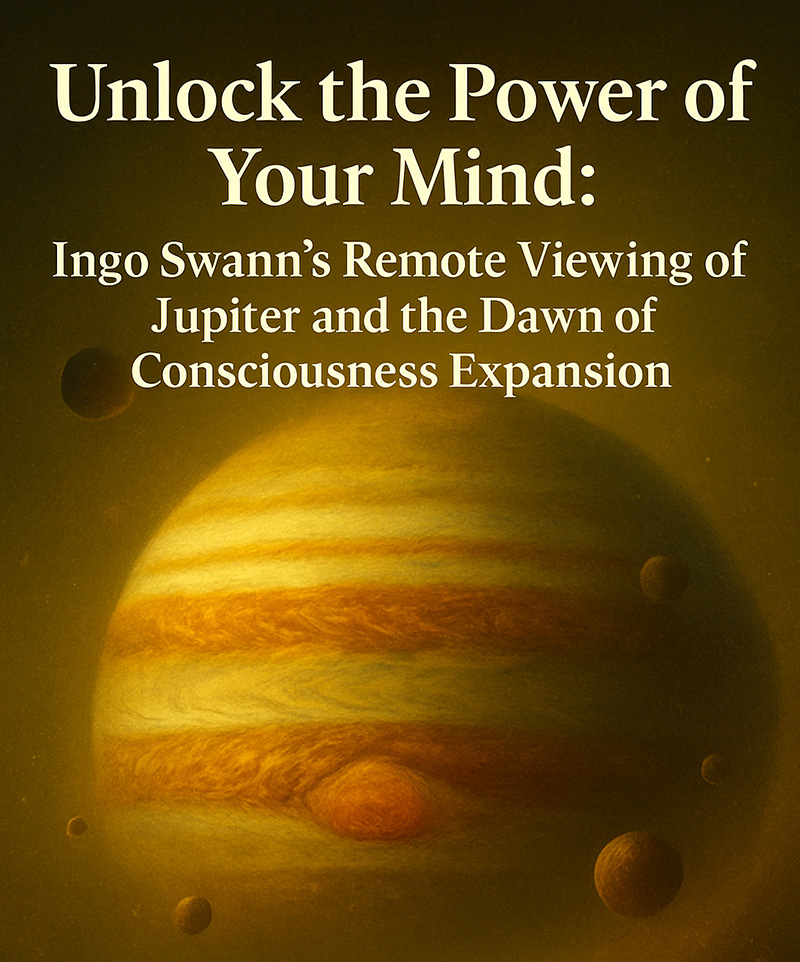
Introduction: The Mind’s Untapped Potential
 In this two-part series, we journey into the extraordinary world of Ingo Swann, a pioneer whose remote viewing abilities challenged scientific boundaries. Part 1 focuses on his 1973 psychic probe of Jupiter, where he described features later confirmed by NASA’s Voyager 1 in 1979. Drawing from declassified CIA documents and Swann’s original session notes, we’ll uncover how this feat inspires meditation to unlock hidden mental powers. Part 2 will dive into his wilder claims of extraterrestrial beings and other dimensions. At Meditation Treks, we see these stories as gateways to mindfulness and inner peace—let’s begin.
Who Was Ingo Swann and What Did He Discover?
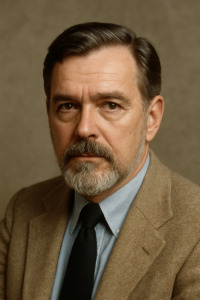
Ingo Swann (1933–2013), an artist from Colorado with no formal scientific training, developed remote viewing—a technique to perceive distant targets using the mind. On April 27, 1973, at the Stanford Research Institute, Swann conducted an experimental psychic probe of Jupiter alongside Axel Sherman, another viewer, in a simultaneous session coordinated by researchers Harold Puthoff and Russell Targ.
Given only coordinates (no prior knowledge of the target), Swann described Jupiter as having a “very high infrared spectrum” with “a poisonous atmosphere” composed of hydrogen, helium, ammonia, methane, and possibly deuterium. He noted “crystals” in the atmosphere, “gigantic storms and wind” that “blow the clouds around,” and “something like mountains” or “very tall things” protruding through the layers.
Crucially, he sketched “rings” around the planet: “There’s a ring… a flattened ring of some kind.” He also mentioned activity on a moon (likely Io): “Volcanic action… orange-yellow with a lot of browns.”Sherman’s independent observations aligned in parts, describing “yellowish” colors, “tremendous turbulence,” and “stratified layers” in the atmosphere. Their results were compared via phone after 30 minutes, showing remarkable overlap despite no communication.
These details, documented in declassified CIA files at the CIA’s Reading Room, were prescient. Voyager 1’s 1979 flyby confirmed Jupiter’s faint rings, massive storms (like the Great Red Spot), hydrogen-helium atmosphere, and Io’s volcanic activity—features unknown in 1973. While some elements (e.g., solid mountains) didn’t match Jupiter’s gaseous nature, the accuracies intrigued the CIA, leading to Swann’s recruitment for the Stargate Project. Swann believed consciousness extends beyond the brain into a universal field, allowing such perceptions—a view echoing quantum consciousness theories explored by institutes like noetic.org.
The Science and Spirituality of Consciousness
 Neuroscience continues to probe consciousness, with 2024 studies (e.g., at neurolaunch.com) suggesting it may transcend physical limits. Swann’s session relied on deep focus, akin to meditation, to access nonlocal information. This fusion of science and spirituality invites us to use mindfulness to awaken similar potentials, blending empirical validation with inner exploration.
Meditation Techniques Inspired by Remote Viewing
Drawing from Controlled Remote Viewing (CRV) protocols developed during the Stargate Project, here are three legit techniques to expand your mind. For deeper study, explore declassified CIA documents and perform a search here.
- Structured Visualization: Sit quietly, close your eyes, and receive a random coordinate (e.g., 12-34-56) from a partner or self-generated. Focus on the coordinate, letting impressions—shapes, colors, or sensations—emerge without forcing them. Record your observations for 15 minutes. Based on CRV Stage 1, this builds initial perception. Learn more.
- Breath-Linked Focus: Inhale for 4 seconds, hold for 4, exhale for 4, and pause for 4. Repeat for 10 cycles while mentally repeating the target coordinate. This calms the mind, aligning with CRV’s preparatory relaxation phase, preparing you for clear perception. Learn More
- Conscious Expansion Exercise: After relaxation, visualize your awareness extending beyond your body, connecting with a target location or concept (e.g., a planet). Spend 20 minutes noting impressions, then review. This mirrors CRV’s advanced stages, aiming for nonlocal awareness. Journal your insights. Learn More.
Join the Journey
 Swann’s Jupiter probe hints at untapped human capabilities, relevant amid 2025’s surge in mindfulness (15% rise in app downloads per App Annie). It reduces stress, fosters clarity, and prepares us for Part 2’s deeper mysteries. Our community offers guided sessions inspired by visionaries like Swann. You can even Journey to your future self. Ingo Swann’s remote viewing challenges our view of reality. His story inspires a deeper dive into meditation’s possibilities. Begin your journey—expand your mind, connect with the universe, and find peace within. Are you ready?
Conclusion: Beyond the Brain
Ingo Swann’s 1973 visions—rings, storms, volcanic moons—proven by science, inspire us to expand consciousness through meditation. As he reflected, remote viewing reveals “a universal field” we all share. Ready for more? Stay tuned for Part 2.




2 Comments
Lena S.
says:Ingo Swann’s work on consciousness transcending physical limits really resonates with what I’m seeing in my sound healing practice – clients consistently report expanded awareness when we layer frequency work with intention. I’ve found that most consciousness tools miss the personalization piece, which is where something like Quantress stands out for me, since it matches audio frequencies to your specific archetype rather than one-size-fits-all approaches. Have you experimented with how personalized frequency alignment might deepen the remote viewing states you’re exploring?