
When you turn the beat rate in Meditation Treks, you are naming one number — how many pulses you want each second. The apps can draw that pulse three different ways: binaural beats, monaural beats and isochronic tones. Same carrier slider. Same beat slider. Three different waveforms are in the air — or, for binaural, mostly in your listening.
One number, three textures
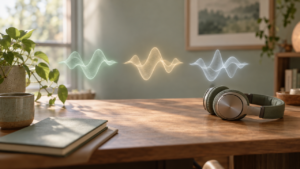
In the apps, carrier mostly lives around 150–600 Hz, and beat runs from a slow pulse up to 50 Hz.
At the fast end, binaural gets hard to hear as a beat, while monaural and isochronic still feel clear. The photos and diagrams below do most of the explaining — I am just naming what you are looking at. That difference is one reason I offer all three — not as marketing tiers, just as different ways to draw the same pulse.
Binaural beats
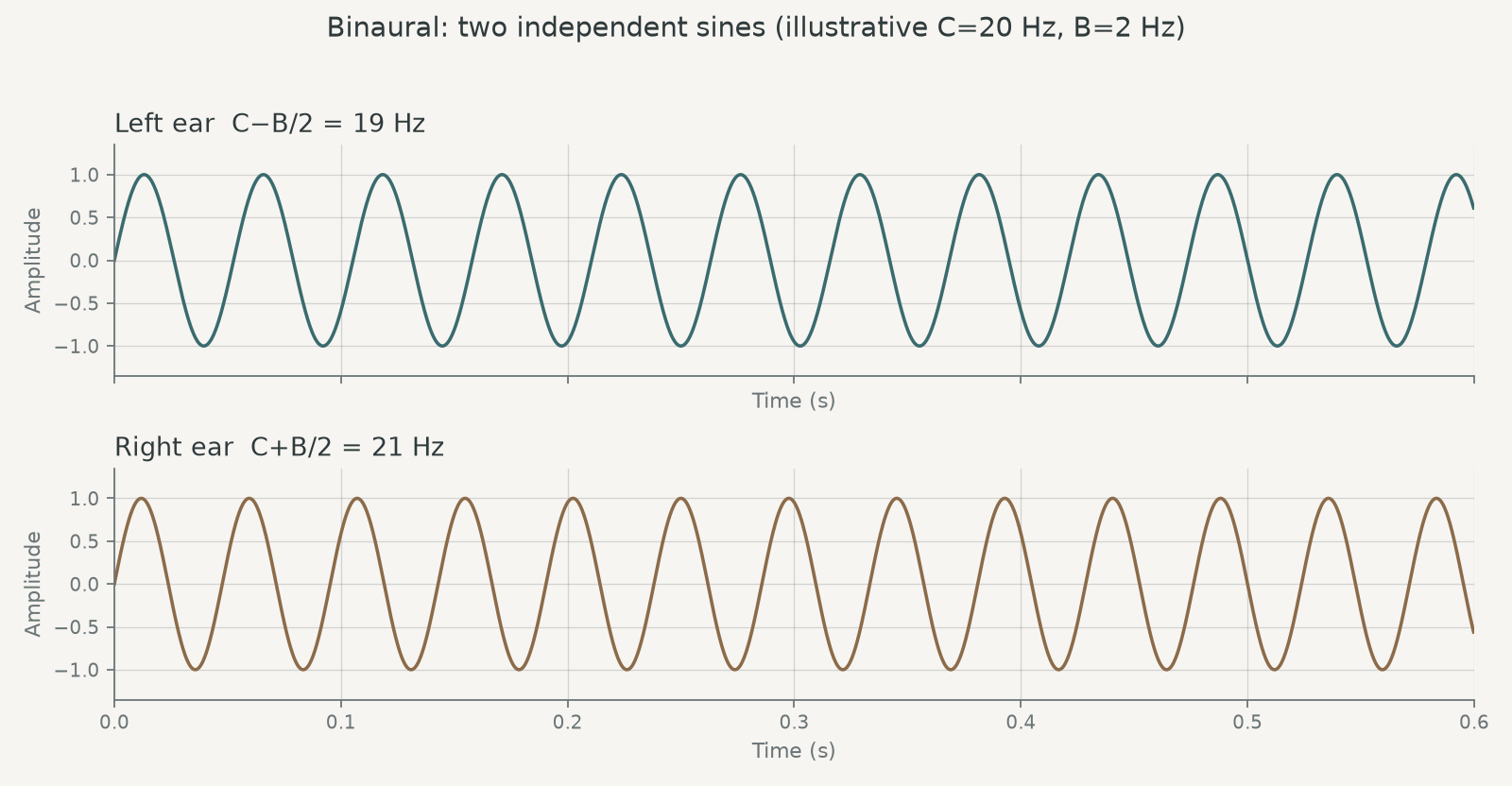
Binaural sends a slightly different tone to each ear. The pulse is not really in the recording — your brain invents it by comparing the two sides, in a place researchers call the medial superior olive.
That is why it wants headphones. On a phone speaker the two tones mix in the room and the magic collapses. Meditation Treks players — both the apps and the site — keep a hard left/right split for this mode so each ear stays clean.
I use binaural when I am wearing headphones. But binaural beats won’t behave on a kitchen speaker.
Monaural beats
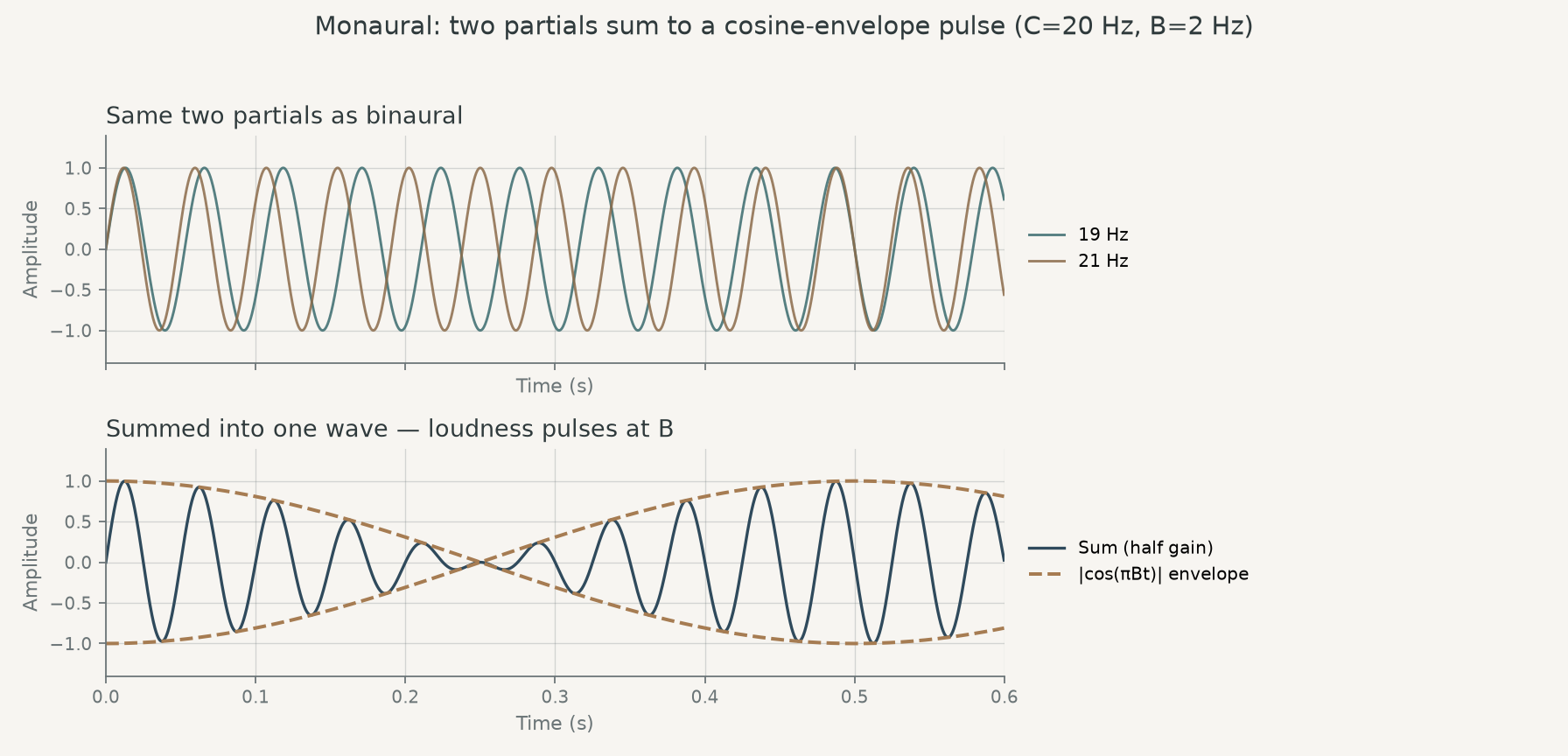
Monaural takes those same two tones and sums them into both speakers, so the loudness pulse is already in the air. A phone speaker can deliver it.
For the same C and B, the frequencies match binaural. If it sounds a little brighter on a tiny speaker, that is the speaker and the room talking — not a different pitch in the synth.
This mode lives in the apps. The website player stays on binaural and isochronic.
Isochronic tones
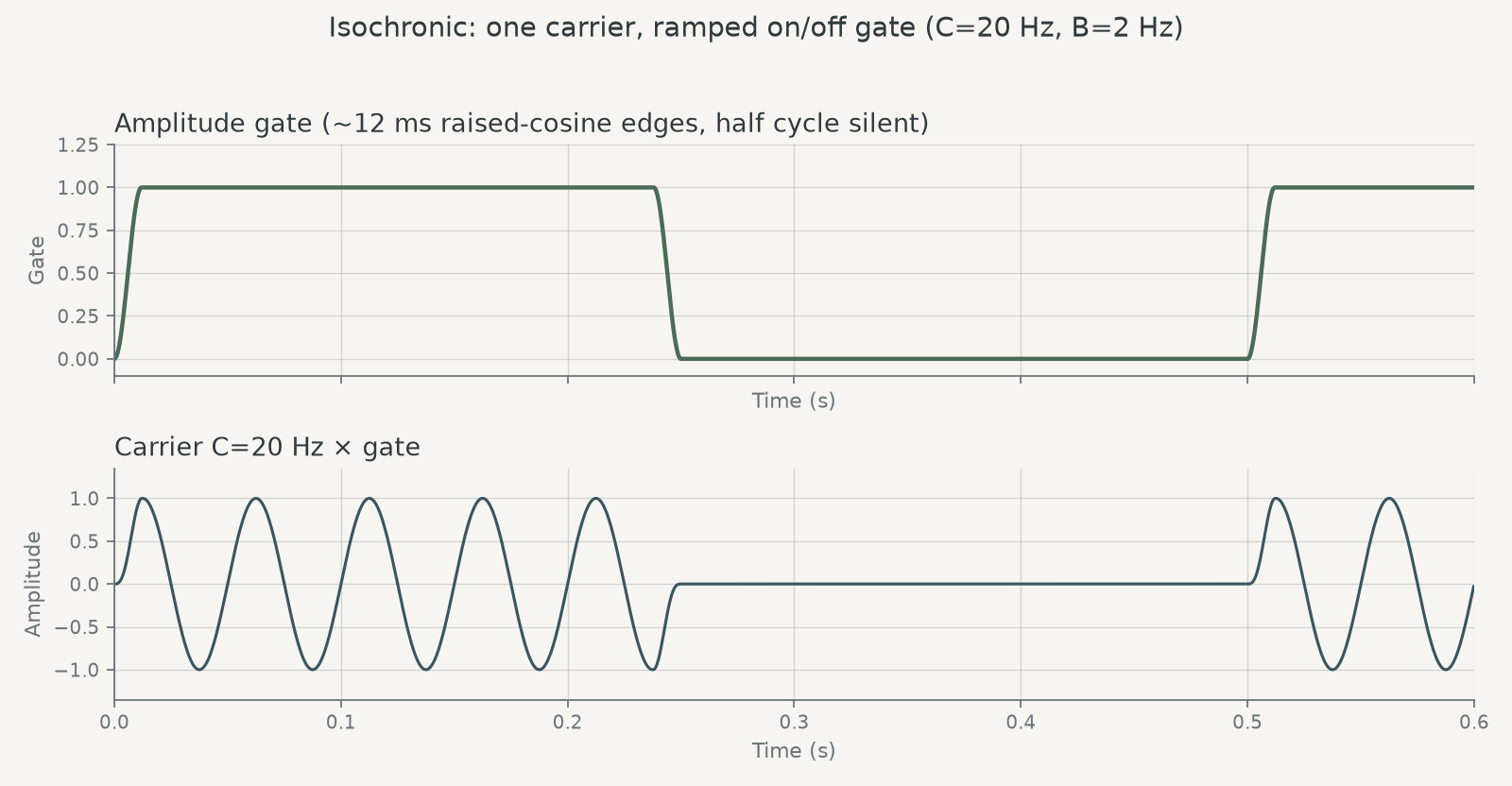
Isochronic is one tone turned gently on and off. Half of each beat is silence; soft edges keep it from clicking.
Volume is your control — there is no depth knob. The same gated pulse runs in the apps and on the website player.
Compared with the other modes at the same slider settings, it often feels quieter because half the time there is nothing there. Match them by ear.
What studies report

Research draws the same split you can hear: monaural works on speakers because the pulse is physical; binaural needs a separate tone in each ear (Chaieb et al., 2015; Oster, 1973). Garcia-Argibay, Santed, and Reales (2019) pooled 22 studies and found a modest average effect across attention, memory, anxiety, and pain measures — larger with longer listening, still not a personal guarantee. Reviews of brainwave claims on EEG are mixed (Ingendoh, Posny, and Heine, 2023), and monaural and binaural do not always do the same thing in the lab (Becher et al., 2015; Engelbregt et al., 2021). These are listening tools for practice, not treatment. For the longer Journal tour, see The Science Behind Binaural Beats.
Where a pulse could sit later

Today the pulse sits in the center. Later, a simple left/right balance like the noise and nature layers already have could place a monaural or isochronic tone in the stereo field — and a possible 3D feature.
What changed in 1.1

Both apps are version 1.1. Version 1.0 labeled Isochronic on a swell that never went silent — that was a bug. 1.1 replaces it with the real gated pulse, and adds Monaural so the beat works on a phone speaker.
Headphones and a classic beat? Stay with binaural. Want the pulse in the room? Try monaural or isochronic. Meditation Treks stays offline, one purchase, not a subscription — listening tools for practice, not medical advice.
This is a listening-tools essay, not a treatment claim. The offline Meditation Treks app synthesizes these tones live. The free binaural beats web app offers binaural and isochronic, and the Tools page has the rest. For the older research map of binaural listening, start with The Science Behind Binaural Beats.