

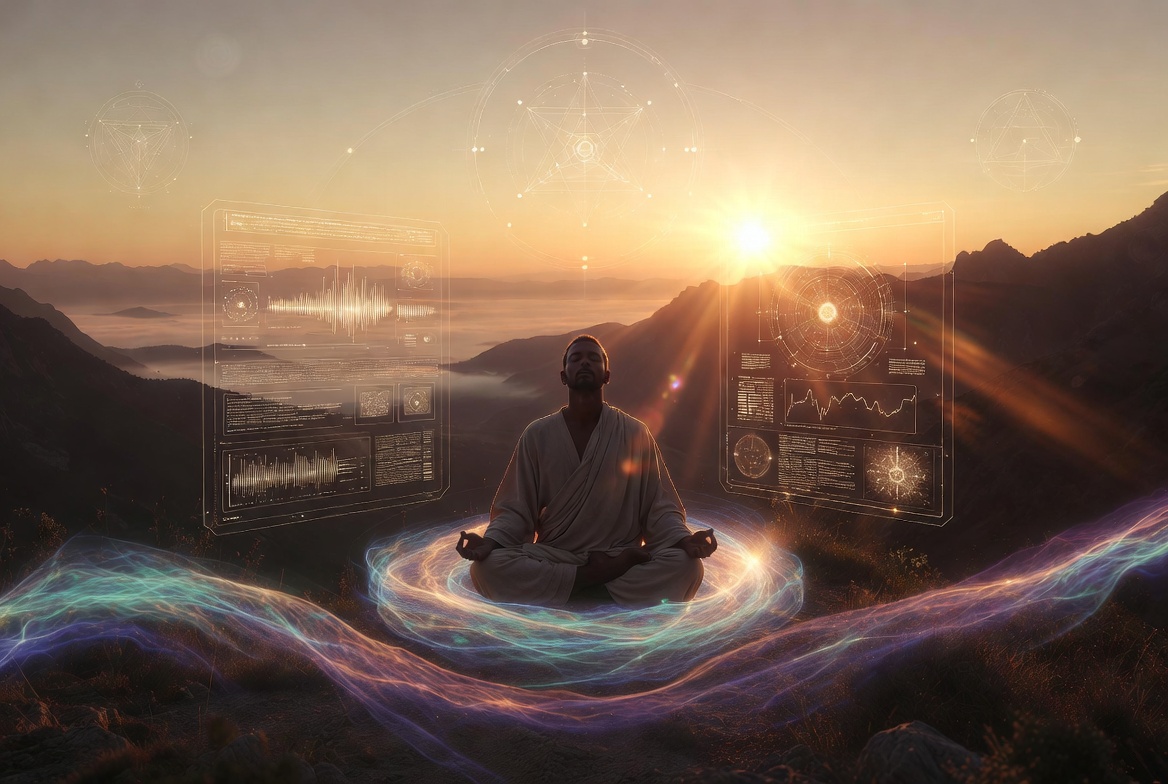
In the quiet moments of meditation, when distractions fade and intention rises, a powerful question emerges: How can we evolve our practice as our consciousness grows? At Meditation Treks, we’ve long embraced technology—binaural beats, bilateral EMDR tools, and guided audio—as allies on the inner journey. Today, artificial intelligence (AI) stands as one of the most transformative tools available.
As a software engineer who has embraced AI for years, I’ve seen its impact across both professional and inner landscapes. In the tech world and beyond, the often-heard warning is that AI will replace jobs and creative roles. But the deeper truth is this:
AI isn’t going to replace you. The person who knows how to use AI will replace you. Be that person.
 This applies powerfully to your career—whether you’re engineering software, creating content, leading teams, writing music, or pursuing any path. Those who learn to collaborate with AI gain a massive edge. Think of it like this: When you need to dig a hole, if one person shows up with a spoon and another with an excavator, who are you going to hire? On the one hand, the excavator yields speed and power, but you don’t want to hire the person who doesn’t know how to operate it—they can do a ton of damage. Skill with the tool matters more than ever.
When guided skillfully, AI amplifies human intention and awareness. It frees mental energy for higher-level work: strategy, creativity, system design, and the deeply human elements that no algorithm can replicate.
Judging Art by the Tools Used to Create It
 Many people are opposed to AI in art, but how many times has new technology created rifts in the art world, only to become mainstream later? Upon seeing a photograph for the first time around 1840, the famous French painter Paul Delaroche declared, “From today, painting is dead.” Critics said photography required “no human touch” and therefore had no soul. Sound familiar?
When synthesizers, drum machines, and autotune first entered the music world, many called them cold, clinical, and “unreal.” Drum machines were criticized as cheating. Digital editing was said to flood the industry with amateurs who hadn’t “paid their dues.” Yet today these are accepted tools, and no one wants to hear out-of-tune singers. In my opinion, when it comes to music and art:
if it sounds good, it probably is
AI as Your Mindful Companion
 When directed by clear intention—the foundation of effective meditation—AI becomes an empowering ally. People with no coding skills can create applications that work. Experienced software engineers can focus on system design and guiding best practices instead of repetitive tasks. Writers no longer wait weeks for editor feedback. The vast information we once had to hunt across websites and search engines is now available in natural conversation. We can ask AI for sparks of inspiration or take our own ideas all the way to the finish line.
By mastering AI in your career and personal life, you step into greater agency and awareness on every trek.
AI at Meditation Treks: Real-World Examples of Amplified Intention
We’ve integrated AI thoughtfully here at Meditation Treks to support your practice:
- Software: The EMDR Bilateral Sound Tool and binaural beats generator on this site were built quickly using audio concepts and AI assistance.
- Guided Albums: The last Guided Meditation Treks album was written in cooperation with the Meditation Treks Guide, a custom GPT fine-tuned from previous albums. It was also used to write Sonic Pi scripts that generated some of the music.
- Custom AI Assistants: We also offer several other AI Personas such as a custom GPT inspired by Ra from The Law of One. I strongly encourage you to have direct conversations any of these bots—ask for personalized guidance or deeper insights tailored to your current intention and stage of practice.
- Content Creation: This very blog post was created by iterating with AI, and nearly every image on the site over the last two years was generated with AI instead of stock photos. None of it would carry the same heart without human intention guiding the process.
Practical Prompt Examples
(Copy, adapt, and infuse with your intention, then continue the conversation with the Meditation Treks Guide):
- Guided Meditation Prose:
“Write a 7-minute guided meditation script on cultivating inner peace. Include nasal breathing cues, a gentle forest visualization, and affirmations that amplify personal empowerment. Keep the tone calm, warm, and meditative.” - Binaural/Frequency Design:
“Suggest binaural beat settings for deep relaxation (target 4-7 Hz theta) combined with isochronic tones. Recommend carrier frequencies and complementary ambient elements for healing breathwork.” - Therapy/EMDR Reflection:
“Generate 5 reflective journaling prompts for post-EMDR bilateral stimulation. Focus on positive reprocessing, insight integration, and self-compassion.” - Conversation with Ra (example prompts):
“Can you describe the physical and metaphysical landscape of Earth once it is fully established in the fourth density? How do fourth-density positive entities interact with the planet’s geography?”
Or: “What happens to souls who are neither polarized enough for the positive harvest nor the negative harvest, but have advanced too far to repeat a standard third-density cycle?”
Use these after setting a clear intention. Review, refine, and iterate—this process itself strengthens both your prompting skills and meditative awareness.
Navigating Challenges: Stay Empowered and Present
 AI isn’t flawless. Challenges include hallucinations, over-reliance that can weaken personal discernment, and the tendency to act as a sycophant—reinforcing whatever path you take it down, for better or worse. In your career, the same risks exist: becoming too dependent on tools instead of honing your unique human strengths.
Meet these with mindfulness:
- Begin every interaction with a clear intention.
- Critically evaluate and personalize every output.
- Use AI to support, not replace, core practices—it will never replace silent sitting, breathwork, or real human connection.
Handled skillfully, these challenges deepen your awareness and reinforce your role as the conscious guide.
Step Into Your Power
 AI will not replace you—in your career, creative pursuits, or meditation practice. But the person who learns to use it with intention and awareness will thrive. At Meditation Treks, our mission remains the same: providing evolving tools and practices that support your growth.
Explore our EMDR bilateral sound tool, binaural beat generator, guided albums, and other resources. Then experiment with AI companions like Grok, the Meditation Treks Guide, and Ra as thoughtful allies on your path.
What will you manifest next? Share your experiences using AI for meditation, healing, or career empowerment in the comments. Together, we move forward—more aware, more intentional, and fully empowered.